How to Practise Interviews Out Loud (Not Just in Your Head)
Typed answers fall apart when you have to say them. A practical routine for rehearsing interviews out loud, handling follow-ups and reviewing your transcript.
By the Mecverse team · 7 Oct 2026 · 7 min read
Key takeaways
- Writing answers trains you to edit. Interviews reward you for speaking clearly in one take, so rehearse by speaking.
- Prepare five stories as bullet points, not scripts, so you can tell them in any order the interviewer needs.
- Follow-up questions are where most answers break. Practise with someone (or something) that asks them.
- Review a transcript of every session with four questions: was it clear, specific, structured, and right for the level?
- Two short sessions a day with a written fix after each beat one long session on the weekend.
Why typed answers fall apart when you say them
Picture a final-year engineering student a week before campus placements. She has a Google Doc with polished answers to "Tell me about yourself", "Walk me through your project" and "Why should we hire you?". She has read it ten times. Then the HR round starts, the first question comes, and the answer that looked perfect on screen comes out as two false starts and a long "so basically".
Nothing was wrong with her preparation except the format. Writing and speaking are different skills. When you type, you can pause for thirty seconds, delete a sentence, and move the best point to the top. When you speak, the first sentence is already out before you know how the third one ends.
| What changes | Typing an answer | Saying an answer |
|---|---|---|
| Order | You can rearrange later | Whatever you say first sets the frame |
| Length | You see the length on the page | You lose track of time after about a minute |
| Recall | The notes are in front of you | You pull the details from memory, under pressure |
| Filler | Invisible | "Basically", "like" and "so yeah" fill every gap |
| Follow-ups | None. The doc never asks "why?" | The next question depends on what you just said |
Speaking practice is uncomfortable for exactly this reason. It shows you the gaps that a written draft hides. That discomfort is the useful part.
Before you speak: build a story bank, not a script
Memorised scripts fail in two ways. You sound like you are reciting, and when the question arrives in a slightly different shape, the script does not fit. A story bank works better: a handful of real experiences, each written as four or five bullet points, that you can bend to fit many questions.
For most fresher and junior roles, five stories cover the bulk of what gets asked:
| Story | Answers questions like | Bullets to note |
|---|---|---|
| Your main project | "Walk me through a project", "What was your exact contribution?" | Problem, your part, what shipped, what you would redo |
| A bug or failure | "Tell me about a mistake", "Hardest problem you solved" | Wrong first guess, the clue that changed it, the fix |
| A disagreement | "Conflict with a teammate", "Time you pushed back" | What you disagreed on, what you did, how it ended |
| A missed deadline | "Working under pressure", "A time you failed" | When you told people, what you changed next time |
| Why this role | "Why us?", "Where do you see yourself?" | One detail from the job post, one thing you did that proves fit |
Add at least one number to each story if you honestly have one: how many users, how long it took, how much faster it got. Interviewers remember a number long after they forget the adjectives.
A 25-minute practice routine you can repeat daily
Long weekend sessions feel productive, but you get one round of feedback and a tired voice. Short daily sessions give you a feedback loop. This is a routine that fits before college or after work:
- Prepare (3 minutes). Pick the role and two stories you want to test. Glance at the bullets, then put the card face down.
- Interview (10 minutes). Answer out loud, standing or sitting the way you would in the real round. Use a friend, a mentor, a recorder on your phone, or an AI interviewer. Do not stop to restart an answer. Recovering mid-sentence is part of the skill.
- Review (10 minutes). Read or listen back. Use the checklist in the review section below.
- Write one fix (2 minutes). One sentence, such as "Say what I built before the tech stack". That fix is the goal for tomorrow's session.
A sample week
| Day | Focus |
|---|---|
| Monday | "Tell me about yourself" plus your main project |
| Tuesday | Same two, applying Monday's fix |
| Wednesday | Bug or failure story, disagreement story |
| Thursday | Fundamentals for your role, explained in plain words |
| Friday | A full mock aimed at a specific job description |
| Weekend | Reread the week's fixes. Update the story cards. |
Practise the follow-up, not just the first answer
The first question is the one you prepared for. The second one is where the interviewer finds out whether you understand what you said. "You mentioned caching. Why there?" "What was your part, versus the team's?" "How did you know it worked?"
A fixed list of questions cannot ask these. You need a partner who listens and digs. When you get one, these habits help:
- Answer first, then explain. "I would add an index on the user ID column. Here is why." The interviewer knows where you are going.
- Say "I" before "we". Team projects are fine. Make your own boundary clear first, then credit the team.
- Name the alternative. When asked to defend a decision, say what else you considered and what your choice cost you.
- Handle "I don't know" honestly. "I have not used that, but I would start by checking the logs for..." is a real answer. Bluffing usually earns a harder follow-up.
- Ask for a repeat when you need one. "Could you say that again?" costs you nothing. Answering the wrong question does.
How to review your transcript
Listening back to a recording of yourself is painful, and most people skip it. A written transcript is easier to face and much faster to scan. If your tool does not give you one, many phone recorders can transcribe, or you can note answers by hand from the recording.
Go through each answer with four questions. They are the same four dimensions InterviewRoom scores, and they work on any transcript:
- Clarity. Could someone outside your field follow it? Underline every term you did not explain.
- Specifics. Circle every number, name, tool and result. An answer with nothing circled is a summary, not evidence.
- Structure. Does the first sentence answer the question? Can you spot the problem, your part, and the outcome in that order?
- Fit for the level. Would this answer convince someone hiring for this exact role and seniority? An intern answer and a senior answer to the same question should sound different.
Quick checks while you read
- Count filler words in your first answer, then in your last. If the count climbs, you are tiring, and your sessions may be too long.
- Look for answers longer than about two minutes of speech. Most could lose their middle third.
- Find any place where the interviewer had to ask the same thing twice. That is where you were unclear.
- Mark one answer you are proud of. Note what made it work so you can repeat it.
Practising with an AI interviewer
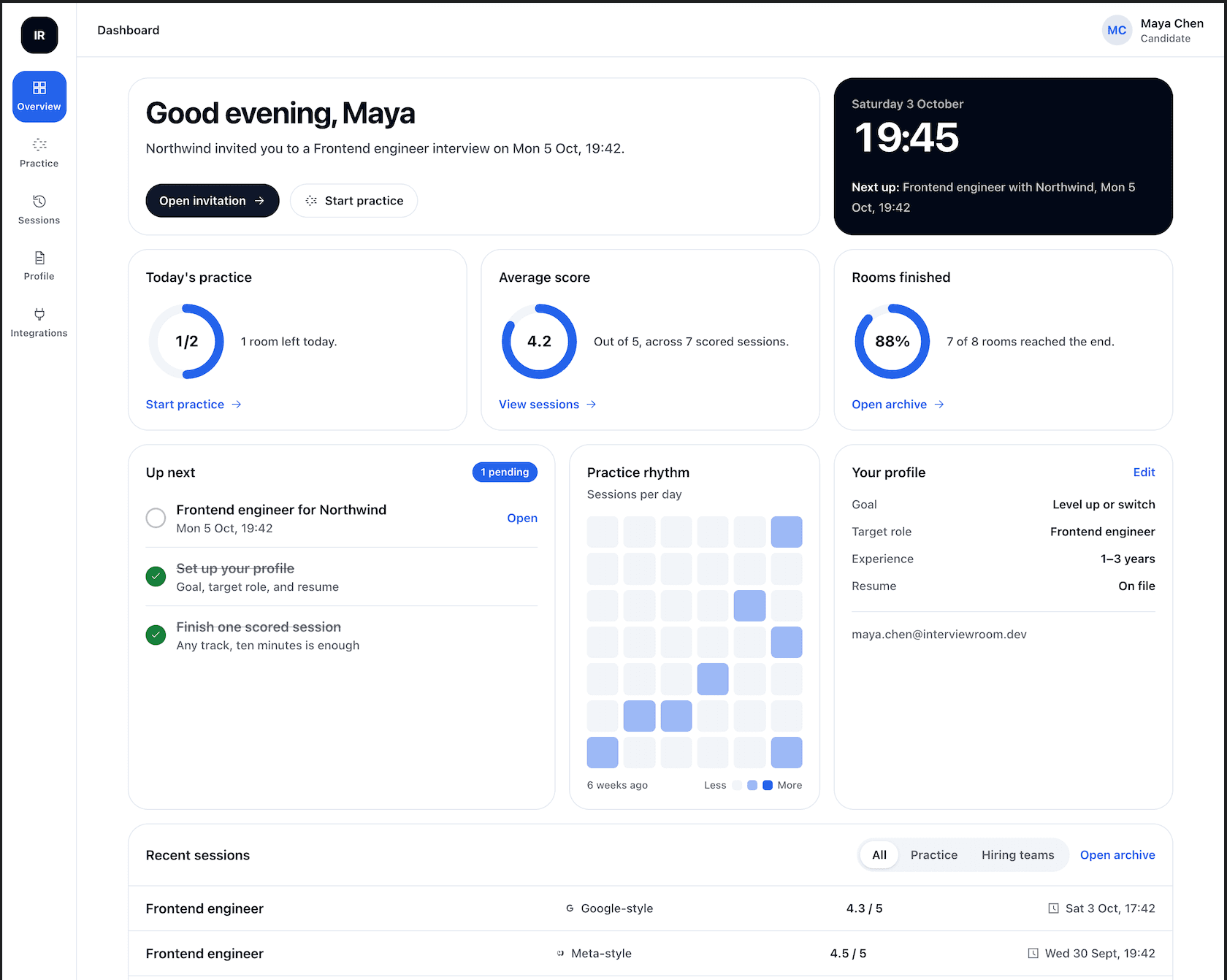
When you cannot find a friend at 11 at night, an AI interviewer can play the other side. We built InterviewRoom for this. You speak your answers, it listens, and it asks a follow-up based on what you just said rather than reading the next item from a list.
How it lines up with the routine above:
- Set the room up for the real job. Pick a track (campus and student, software engineering, or a general role), a seniority level, and the role. You can attach a PDF resume (up to 2 MB) and paste the job description, so the questions match what you are applying for.
- Choose a style. There are company-style rooms inspired by how companies such as Google, Amazon, Flipkart and Infosys publicly describe their interviews. InterviewRoom is not affiliated with any of them.
- Add a coding problem if your role needs one. The interviewer sets one small problem, you talk it through, send your code, and it asks a follow-up. The code is discussed, not executed.
- Interrupt when you need to. Start speaking and the interviewer stops and listens. The question and your answer appear as text on screen while you talk.
- Review afterwards. You get the full transcript and a score out of 5 on four dimensions (clarity, specifics, structure and bar fit), plus what landed and what to fix. Ending early still gives you both.
The free plan gives you two practice sessions a day, up to 10 minutes each, which suits the daily routine above. It runs in Chrome or Edge on a laptop with a microphone, no camera, and the interview is in English. Your speech is transcribed so the interviewer can respond, then the audio is discarded. Only the transcript and any code you send are saved to your account.
If you are curious how the voice side works, our case study on building InterviewRoom and the article on voice AI turn-taking go into the engineering.
Your next seven days: a checklist
- Write five story cards: project, bug or failure, disagreement, missed deadline, why this role.
- Add one honest number to each card.
- Save the job description of one real opening you want.
- Block 25 minutes a day in your calendar for the routine. Mornings work if your evenings are unpredictable.
- Find a follow-up partner: a friend briefed to ask "why?", a senior, or an AI interviewer.
- After every session, read the transcript with the four review questions and write one fix.
- On day seven, run a full mock against that job description and compare it with your first session.
If you only do one thing from this list, make it the first one. Five stories you can tell well out loud will carry you through more interview questions than fifty written answers you have never said.
Frequently asked questions
Run your first practice room
Two free sessions a day, up to 10 minutes each. Speak your answers, take the follow-ups, and read your transcript afterwards.
Keep reading
AI
Best voice AI infrastructure in 2027
Teams building a product that talks do not lose the month on the prompt. They lose it on formats. Twilio sends mulaw at 8 kHz. Deepgram wants PCM at 16 kHz. ElevenLabs returns audi
13 Oct 2026 · 8 min read
AI
AI Chatbots for Business Websites and WhatsApp: How to Scope One
What an AI chatbot on your website or WhatsApp does well, where it fails, how to scope FAQs, lead capture and human handoff, and what drives the running cost.
7 Oct 2026 · 6 min read
AI
How to Run a Fair First-Round Voice Screen With an AI Interviewer
When an AI voice screen fits your hiring, how to set it up fairly with invite links, what to review afterwards, and which decisions must stay with people.
7 Oct 2026 · 7 min read